
Ginny Rentko VMD DACVIM
Leap Years CEO and Chief Veterinary Medical Officer
As a veterinary internal medicine specialist, Chief Veterinary Medical Officer, and CEO at Animal Biosciences – the maker of Leap Years – I’m pleased to share insights on why Leap Years is a cellular health supplement with a monthly regimen to support healthy aging in dogs. We conducted scientific studies to determine the optimal amount and interval of administration as well as a clinical trial of Leap Years. We know from the scientific literature that old cells, aka senescent cells, accumulate and this accumulation is one of the ways cells age.(1) We also know that another way cells age is they lose function of the mitochondria, the energy-producing powerhouse of the cell.(1) Leap Years’ combination senolytic and NAD booster acts on both of these ways of cellular aging. At the start of the monthly regimen, the combination senolytic and NAD booster, aids the body’s natural clearance of those senescent cells and helps the mitochondria to maintain its normal function. Leap Years is a science-backed, daily supplement option for pet parents to help support healthspan, to keep mature dogs more active, mentally sharp, and vibrant for as long as possible.
When it comes to supporting healthy aging in dogs, consistency matters just as much as quality. Leap Years’ soft chew was veterinarian-developed to fit easily into your dog’s daily routine. Use this guide if you’re just getting started with Leap Years or to double-check your monthly administration schedule.
Leap Years monthly regimen starts by giving the golden soft chews from the bag inside the bottle on two consecutive days. These golden chews are the senolytic and NAD booster combined. We call these the combo chew. Following this, the brown chews (NAD booster) are administered for the remaining days of the month.
Watch the video below to learn more:
Weight-Based Administration
How much you give depends on the size of dog. For example, if your dog is <11lbs, you will give ¼ of a chew in your daily regimen whereas larger dogs need one, two or three chews a day described in the administration chart below.
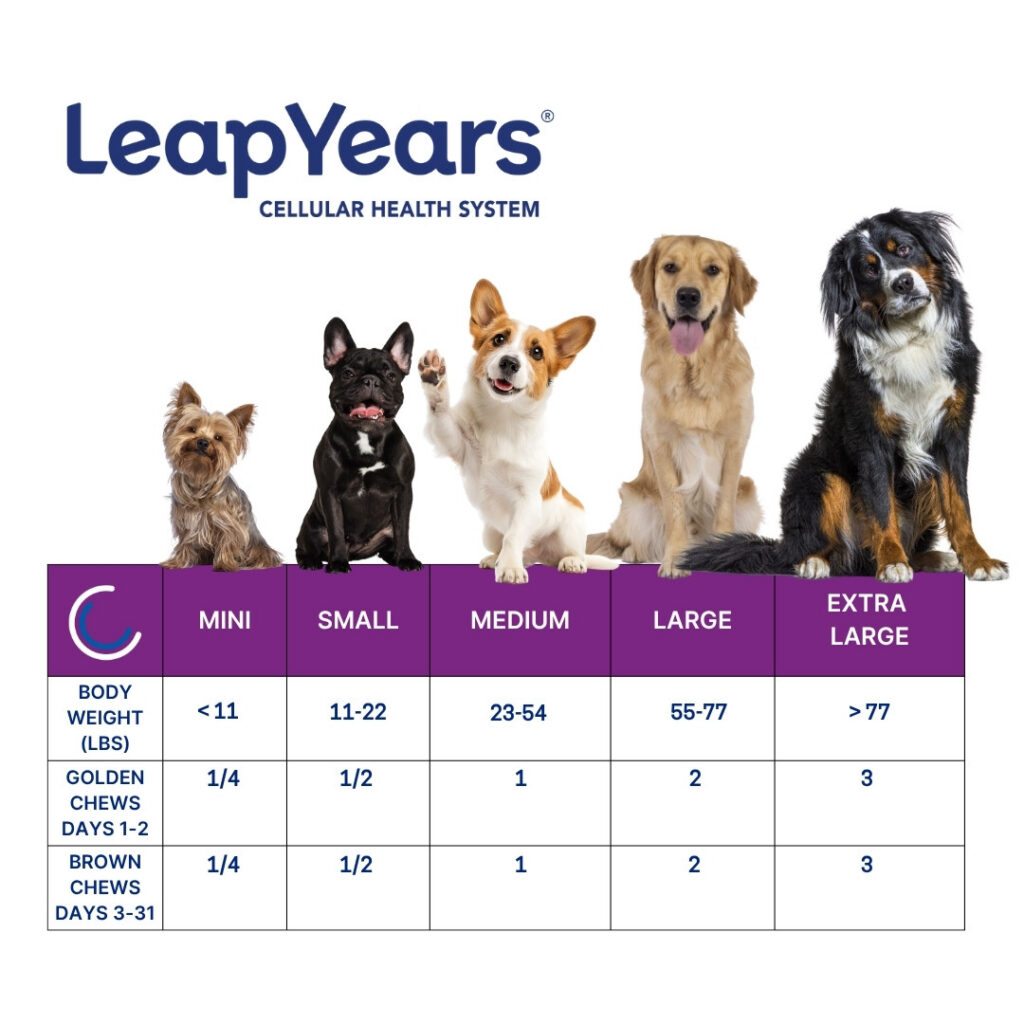
DAILY Weight-Based Guidelines:
- Mini / Very small dogs (<11 lbs): ¼ chew
- Small breeds (11-22 lbs): 1/2 chew
- Medium breeds (23-54 lbs): 1 chew
- Large breeds (55-77lbs) : 2 chews
- Extra-large / Giant breeds (<77 lbs): 3 chews
Use the same number of chews for the combo chew days and the brown chew days. For partial chews, cut cleanly with a knife or pill splitter.
Tips for smooth administration:
- Weigh your dog periodically (e.g., monthly) and adjust if weight changes significantly.
- If your dog has health conditions, is on medications, or takes other supplements, consult your family veterinarian before starting.
- Daily consistency in the month-long regimen maximizes potential benefits.
- The beef-flavored soft chews are highly palatable—most dogs take Leap Years like a treat, directly from your hand or mixed into a small amount of food.
Taking a proactive approach to healthy aging for your dog with regular exercise and sleep schedules, providing enrichment and social interaction and a healthy diet, go a long way to supporting your dog. Leap Years adds to these fundamentals with additional support of cellular health. The bond you share with your dog only grows stronger as they age. Keep your dog’s future filled with vitality and joy with a science-forward approach.
Wishing your dog a healthy aging journey.
Ginny Rentko VMD, DACVIM
References:
- Lopez-Otin C, Blasco MA, Partridge L, Serrano M, Kroemer G. Hallmarks of aging,:an expanding universe. Cell 2023 Jan 19;186(2):243-278. Doi:10.1016/j.cell